Most advertisers don’t fail on Facebook because their product is bad or their ads are ugly. They fail because their budget has no plan. Money gets spread across too many campaigns, switched off too early, or poured into one ad until it burns out.
Smart budgeting is the foundation of every successful Meta Ads campaign. It decides how fast you learn, how long your winners keep winning, and how well you survive the unexpected. This guide explains a simple framework for dividing your budget, shows how a small business could apply it, and covers the practical rules that keep your spend working harder.
Why budgeting matters more than most advertisers think
Meta’s ad system learns from results. The more conversions it sees, the better it gets at finding similar people. That means your budget isn’t just what you spend; it’s the fuel for the algorithm’s learning. An underfunded campaign never gathers enough data to optimize, and an unstructured one wastes money on guesses.
A good budget plan solves three problems at once:
- Discovery: you keep finding new audiences, offers and creatives.
- Stability: your proven campaigns keep generating results.
- Resilience: you can react when something changes, such as a sudden opportunity, a seasonal spike or a falling-performance ad.
The pizza slice approach to budget allocation
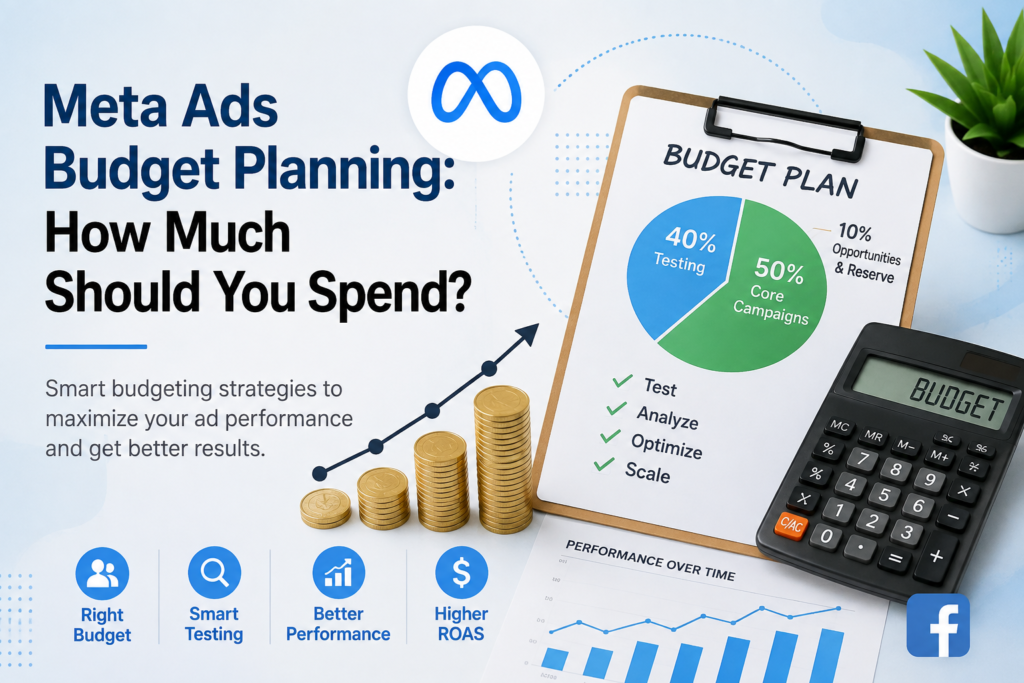
Think of your monthly ad budget as a pizza cut into three slices. A simple, balanced split looks like this:
| Slice | Share of budget | Purpose |
|---|---|---|
| Testing | 40% | Trying new audiences, creatives, offers and placements |
| Proven campaigns | 50% | Scaling and maintaining what already works |
| Reserve | 10% | Unexpected opportunities and quick reactions |
Slice 1: Testing (40%)
This slice pays for learning. Use it to try different audience segments, ad formats (single image, video, carousel), headlines, hooks, offers and landing pages. Test one major variable at a time so you know what caused a change in results. Most tests will fail, and that’s the point. Each failure tells you where not to spend, and each win graduates into your proven slice.
Slice 2: Proven campaigns (50%)
This is your engine. These are the ads and audiences that have consistently delivered results at an acceptable cost. Keep them funded so your business keeps getting customers while you experiment. Watch for ad fatigue: when frequency climbs and results drop, it’s time to refresh the creative using insights from your testing slice.
Slice 3: Reserve (10%)
The smallest slice is the most flexible. Use it to jump on something unexpected: a trending moment, a holiday, a competitor’s pause, a sudden winning test that deserves more fuel, or a new product launch. If nothing comes up, roll it into next month’s testing or proven slice.
The split isn’t a law. A brand-new account with no winners yet may lean heavier on testing, while a mature account with strong campaigns may shift more into the proven slice. Treat 40/50/10 as a starting point and adjust with data.
A small-business example: Tom’s Coffee Shop
To see how this works in practice, take the example of Tom’s Coffee Shop, a small local business that rebuilt its Meta Ads approach in 2024. Tom started with just $300 per month and divided it like this:
- $120 for testing (40%): different audience segments, such as people within a few miles of the shop, office workers and students, along with different ad creatives like latte photos, short behind-the-counter videos and a first-visit discount offer.
- $150 for proven ads (50%): once a test clearly beat the others, Tom moved it into this group and kept it running consistently.
- $30 as reserve (10%): held back for opportunities such as a rainy-day promotion or a local event.
The example reports that within six months, careful budget management and strategic testing led to a 280% increase in local customers. Results like this depend on the business, location, offer and starting point, so treat the number as an illustration of what disciplined budgeting can do, not a guarantee. The lesson is the process: Tom never guessed with his whole budget, and he never stopped learning.
Practical rules for managing your Facebook ad budget
1. Give campaigns enough budget to learn
Meta’s delivery system needs a steady stream of results before it optimizes well. As a rule of thumb, an ad set needs roughly 50 optimization events (for example, purchases or leads) per week to exit the learning phase. If your budget is too small to reach that, optimize for an event that happens more often, or run fewer ad sets so each one gets more money.
2. Don’t judge too quickly
Turning an ad off after a day or two often kills it before it has had a fair chance. Let tests run long enough, usually several days to a week, and make decisions on cost per result rather than gut feeling.
3. Scale gradually
When a campaign performs well, increase the budget in small steps, around 15% to 20% at a time, instead of doubling it overnight. Big jumps can reset learning and hurt performance.
4. Choose the right budget type
Daily budgets give steady spend and are simple for beginners. Lifetime budgets suit campaigns with a fixed end date and let Meta distribute spend across the period. Meta also offers automated budget distribution across ad sets in a campaign; it can work well once you have proven ad sets, but keep an eye on where the money is actually going.
5. Track the right numbers
Don’t stop at clicks. For each slice, watch:
- Cost per result: cost per lead, purchase or store visit.
- ROAS (return on ad spend): revenue earned for every dollar spent.
- Frequency: how often the same person sees your ad; high numbers signal fatigue.
- CTR and conversion rate: whether the creative and landing page are doing their job.
6. Set clear graduation and cut-off rules
Decide in advance what makes a test a winner (for example, cost per result below a target for a set number of days) and what makes it a loser. Winners move into the proven slice; losers are paused. Written rules remove emotion from budget decisions.
7. Review monthly and rebalance
At the end of each month, look at what each slice produced and reallocate. If testing finds winners faster than expected, shift some money to proven campaigns. If proven ads are tiring, give testing more room.
Common budgeting mistakes to avoid
- Spreading too thin: ten ad sets with tiny budgets each learn nothing.
- Never testing: relying only on current winners leaves you exposed when they fade.
- Testing everything at once: changing audience, creative and offer together makes the results unreadable.
- Ignoring the reserve: spending every dollar upfront leaves no room for opportunities.
- Chasing clicks: cheap clicks that never become customers are not a win.
- Making big budget swings: sudden increases or cuts disrupt delivery.
A simple monthly budgeting routine
- Set your total monthly budget based on what you can afford and your cost per customer.
- Split it using the 40/50/10 framework, adjusted to your stage.
- Launch two to four clean tests in the testing slice.
- Keep proven campaigns running and refresh their creatives as needed.
- Check performance every few days, but only act on meaningful data.
- Move winners into the proven slice and pause losers.
- Use the reserve for a timely opportunity, or roll it forward.
- Review results at month’s end and plan the next split.
A bigger budget doesn’t guarantee better Facebook ads, but a smarter one almost always helps. By dividing your spend between testing, proven campaigns and a small reserve, you keep learning without risking what already works. Start small, test with purpose, scale what wins, and let your data decide where the next dollar goes.